
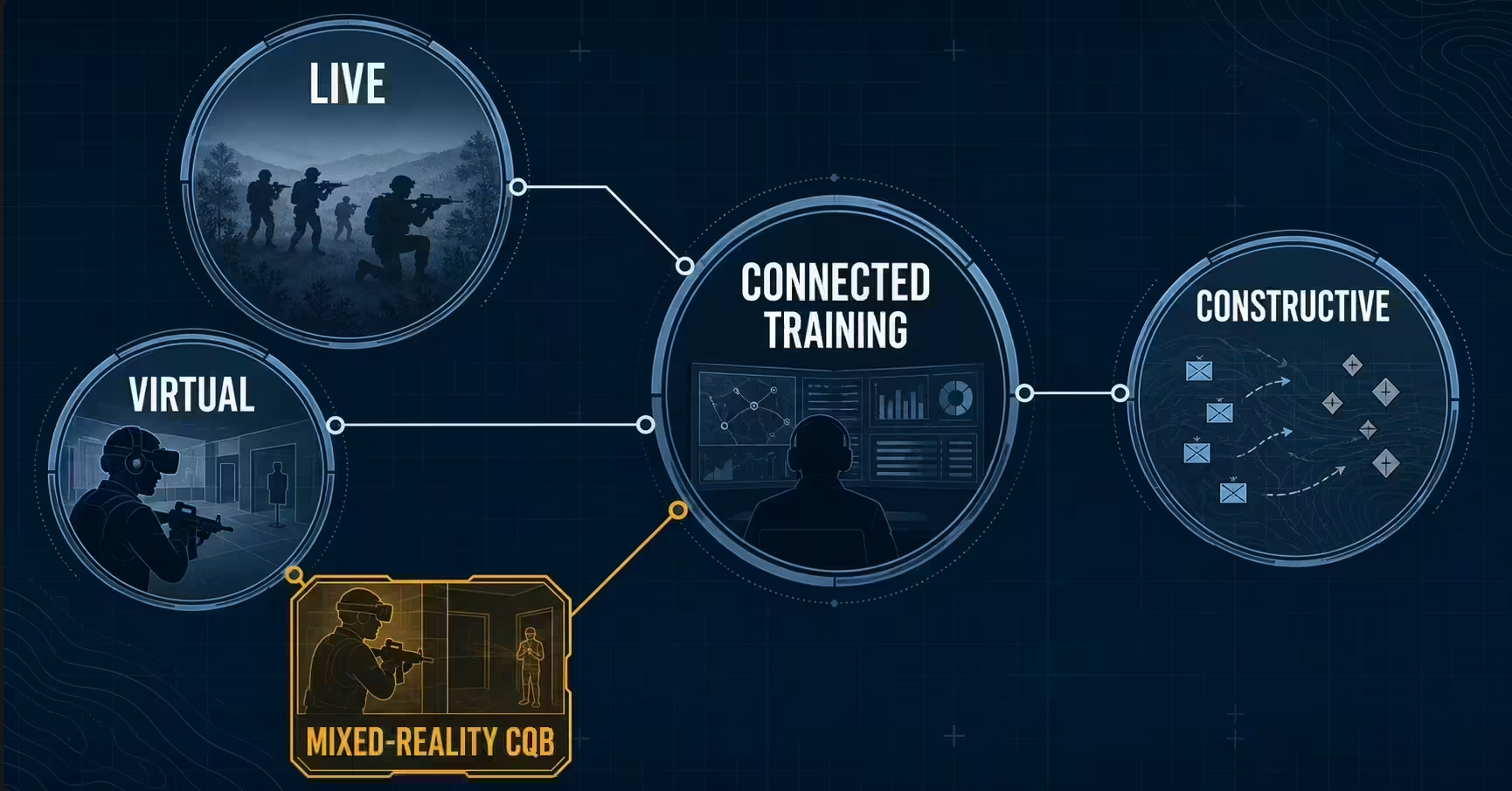
The British Army’s new Collective Training Service makes the direction of travel clear: synthetic training is moving away from isolated simulators and towards integrated live, virtual and constructive environments.
In July 2026, the Ministry of Defence announced that the Raytheon UK-led Omnia Training consortium had been awarded a 15-year contract valued at £2 billion to deliver the Army Collective Training Service, known as ACTS. The service is expected to support the training of around 60,000 soldiers each year using live activity, simulation, data and advanced analytics.
The award does not mean that every training requirement will become virtual. It points instead to a blended model in which different forms of training contribute to a wider system. For suppliers of immersive technology, the important question is therefore no longer simply, “How realistic is the simulation?” It is, “How does this capability contribute to the complete training environment?”
What is live, virtual and constructive training?
Live, virtual and constructive training—usually shortened to LVC—combines several types of activity:
- Live training involves real personnel operating real equipment, normally on a range or exercise area.
- Virtual training places real participants inside simulated environments, using systems such as vehicle simulators, head-mounted displays or immersive training rooms.
- Constructive training uses computer-generated forces, entities and events to represent parts of a scenario that are not being played by human participants.
When these elements are connected effectively, participants can train as part of a larger and more complex scenario than any one facility could reproduce by itself. A dismounted team might operate inside an immersive environment while headquarters staff, simulated supporting assets and other exercise participants contribute to the same training event.
The value comes from integration, not from using technology for its own sake.
Why CQB creates a distinct synthetic-training requirement
Close-quarter battle training presents challenges that are different from those found in a command-post exercise or a desktop simulation. Movement, weapon orientation, communication, spatial awareness and rapid decision-making all matter. The training system must allow instructors to observe not only what a participant decided, but how the individual or team moved through the environment.
Traditional live facilities remain essential, but they can be costly to configure and may limit how quickly instructors can repeat or alter a scenario. Mixed-reality CQB training can provide a complementary environment in which teams rehearse procedures, encounter repeatable situations and review their actions before moving into more resource-intensive live activity.
This is where a specialist immersive system can make a useful contribution to a broader LVC architecture. It does not need to replace the entire training stack. It needs to perform a defined training function and exchange the information required by instructors and the wider exercise.
Five integration questions that matter
1. What is the training objective?
Visual fidelity is not a training objective by itself. Before selecting or integrating an immersive system, the customer needs to define the behaviour, decision or team performance that the activity is intended to develop or assess.
For CQB, that might include threat identification, fields of fire, communication, use of cover, adherence to a tactical procedure or the team’s response to a changing situation. The scenario, data captured and after-action review should all support that purpose.
2. What data needs to leave the system?
An immersive training session can generate substantial data, but more data does not automatically produce better learning. The useful information may include participant position, weapon orientation, engagement decisions, timing, communications or instructor observations.
Customers should establish which data is meaningful, how it will be timestamped and whether it can be correlated with events from other parts of the exercise. They must also decide who owns the data, where it is stored and how long it should be retained.
3. How will instructors control and review the scenario?
Instructor tools are as important as the participant’s visual experience. Staff need to start, pause and modify scenarios, observe performance and introduce events without creating unnecessary technical workload.
After-action review should help connect an outcome to the actions that produced it. Position tracking and scenario-event data can allow an instructor to reconstruct a participant’s movement and decisions, but the technology must support professional judgement rather than replace it.
4. Can the system operate at the point of need?
A capability may be required in a permanent training building, an adapted room or a deployable setting. Physical footprint, setup time, tracking requirements, networking, support and instructor staffing all affect whether it can be used consistently.
Portability is therefore more than the ability to transport equipment. It includes the time and expertise required to turn a location into a reliable training environment.
5. How will the capability evolve?
A 15-year service such as ACTS will outlast several generations of display, computing and networking technology. Training systems need an upgrade path that does not require every scenario, integration or instructor process to be rebuilt whenever one component changes.
Open interfaces, modular architecture and clearly documented data structures can reduce that risk. Specific security and assurance requirements will depend on the deployment and the information being processed, so those questions need to be considered at the design stage rather than added at the end.
Integration is more important than replacement
The ACTS announcement should not be read as proof that a particular immersive technology or training method has been selected for every part of Army training. Nor does it establish that Agincourt or BattleVR is involved in the programme.
What it does demonstrate is a long-term commitment to digitalisation, simulation, analytics and a different relationship between Defence and industry. The published procurement scope includes simulation and emulation, instrumentation, specialist support, observation and review among the services expected from the training partner.
For specialist technology companies, this changes the commercial and technical proposition. The strongest offer is unlikely to be a standalone simulator positioned as a replacement for the wider environment. It is more likely to be a bounded training component that can contribute to a prime contractor’s architecture, an established facility or a customer’s training pathway.
Agincourt’s approach to connected synthetic training
Agincourt’s BattleVR synthetic soldier training platform is designed for immersive military and law-enforcement training, including close-quarter scenarios. The platform combines free movement, tracked training weapons, repeatable scenarios and after-action review.
Agincourt’s wider portfolio addresses other parts of the training workflow. The HAWK synthetic interface provides 2D and 3D simulation and exercise-control functions, while metaCAN is being developed to connect synthetic environments, distribute scenarios and bring instructor controls and performance information into a shared environment.
These capabilities are relevant to an integrated training environment only when they are connected to a defined requirement. Questions about footprint, instructor workflow, scenario design, data exchange and system integration should therefore form part of an early technical discussion—not follow a product demonstration as an afterthought.
See Agincourt’s broader military synthetic training capability and our evidence and evaluation guidance when defining the training case and measures of success.
Organisations assessing mixed-reality firearms, CQB or connected synthetic training can contact Agincourt to discuss the training requirement, deployment environment and integration considerations.
Sources
- Ministry of Defence: AI battle lab to prepare British Army for modern warfare, 10 July 2026
- Find a Tender: Army Collective Training Service procurement scope
Related capability: Explore military synthetic training and the BattleVR platform for configurable CQB and mission-rehearsal exercises.